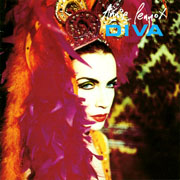
Diva
Annie Lennox
1992: RCA/BMG 74321 33102 2
To anyone—and I do mean anyone—who has known me since the mid-1980s, it is probably baffling to say the least that I have written almost nothing about Annie Lennox’s first two solo albums in the years I’ve been presenting commentaries on the various contents of my CD collection. The same silence notably plagues my Joni Mitchell collection, interestingly…. I suppose the reason behind it is that first of all there is so MUCH to say and to celebrate that it’s daunting to even find a starting-point, and at the same time so much has been said about these by so many other people (rightly or wrongly, for better or for worse) that it seemed more urgent to showcase stranger and more obscure items worthy of attention such as [x] or [y] until I was ready to seriously wax up my eloquence.
To my own surprise I’ve found that I’ve held off on approaching this particular album partly because I simply haven’t come even close to appreciating it fully. Again, an odd thing to be said by one who’s listened to it thousands of times. This note however has to do with the fact that I tend to hear each song as a whole, a fully-formed entity shining among other such jewels in this musical crown, and to take its melody, structure, and lyrical import as the sum of the song in question…yet a casual listen on good headphones can reveal artistic richness at every turn, especially in the form of Annie’s background-vocal chordings and delicate piano-chord splashes.
“Money Can’t Buy It” is an excellent case in point: a strong track on many levels and a subtly solid song regardless of production (it could be “unplugged” without losing a shred of its power as long as it were Lennox delivering especially at the climax), it struts in almost mysteriously and hypnotically, full of shimmering illusion and magic of as-yet-uncertain nature, before laying out a floor plan, and it builds on that only ironically. Lyrics stressing almost Zen freedom from materialism dissipate rapturously into an airy inner voice oddly in emotional uncertainty for such alleged tranquility, and then the song explodes into declamatory might and a “white-girl rap” which then swirls and strains and struggles to channel the energy back to the avowed belief in “love alone”…which it does achieve, with a glorious wrenching cliff-hanger of a climax that drops us back into two of the opening theme’s grooves, with a mix of calm and tension gently starting and stopping, never resolving. And somewhere amid all that (especially in the chorus preceding the “white-girl rap”), Steve Lipson’s mix manages to turn Annie’s voice into something like the live-electricity sound Perry Farrell had in Jane’s Addiction recordings such as “Ain’t No Right” and “Three Days” (although I hasten to concede that for all its rollercoaster-ing glories “Money Can’t Buy It” can’t touch “Three Days”).
That’s just a brief description of one of these songs, and it gets even more profound and complex when you consider the excellent Sophie Muller video for it. Not every track on Diva gets as cinematically expansive as “Money Can’t Buy It” does, but many of them do and none of them is weak except in immediate comparison to stronger tracks on the same album. “Stay By Me,” for example, is strangely slow and laden by comparison to most of the album, but on its own it’s a rain-washed piece of gorgeous work which even in my most cynical moods I can’t dismiss.
I have both the U.K. and U.S. editions of Diva so that I can have these two versions of “Little Bird,” although the “single” edition is different even beyond these two (and remixes go beyond that). That “Little Bird” is a core Lennox gem is unmistakable, as is its lyrical message (whether you read it as being directly autobiographical or not); its might as a recording (regardless of the two main versions available) is even stronger, as is Lennox’s singing, which ranges from worn confession to mighty shouts of triumphal power (the third verse is probably the best example of the latter, and it infuses the following chorus with that same firepower).
And I actually do quite like “Why,” albeit more because of its excellent video, even though I don’t call it out here automatically as a standout track; lyrically it’s great, and melodically too, and the vocal/dramatic performance is perfect, but maybe the synth-pad base puts me off a bit. Such a minor detraction, though! As for what it’s about, we have both Annie saying it’s a song to herself and Dave saying it’s to him; both are probably accurate and not contradictory.
Is “The Gift” about her and Dave Stewart? I’ve never been sure, but listening to it some 14 years after she recorded it, with Eurythmics’s Peace and Boxed and “I’ve Got a Life” having come much later, I think it may well be, at least in large part. As is usually the case with Annie’s lyrics (leaving aside for the moment “You Hurt Me (And I Hate You)”), these lyrics are flexible and applicable enough to any number of situations and relationships—hers as well as anyone else’s—and of course it’s an abstraction as well as a personal reflection…that’s one of the reasons we love her, after all. Her portraits aren’t exact self-portraits, nor are her hyperboles far from her own spine.
Comments © 2006 Mark Ellis Walker, except as noted, and no claim is made to the images and quoted lyrics.