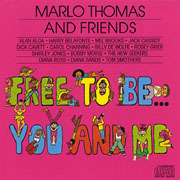
Free to Be… You and Me
Marlo Thomas and Friends
1972: Arista ARCD-8325
The New Seekers
Mel Brooks & Marlo Thomas
Diana Ross
Billy De Wolfe
Harry Belafonte & Marlo Thomas
Carol Channing
Tom Smothers
Marlo Thomas
Billly De Wolfe, Bobby Morse, & Marlo Thomas
Rosey Grief
Sisters and Brothers
Dick Cavett
Alan Alda & Marlo Thomas
Alan Alda & Marlo Thomas
Diana Sands
Jack Cassidy & Shirley Jones
Bobby Morse& Marlo Thomas
Marlo Thomas
The New Seekers
I first heard this in probably 1973 or 1974 (my home town was always a little behind the times), at the home of a local Methodist pastor and his wife, and I have always had a copy at hand in one form or another since then because I truly do love this album and what it stands for.
I wish I could be as enthusiastic about the film itself, but it was an uneven affair that doesn’t translate well from its original context. I watched it once in the late 1990s and had to concede that its impact was a thing of the past, MY past anyway, the bulk of the video playing awkwardly at best to my jaded adult eyes. The CD doesn’t suffer in this way, not at all: I still love all of it—and in new ways as I continue to live and develop.
The themes of equality and commonality (in a sympathetic sense) resonate most and make me wish everyone could hear and concur…so many years of painfully reiterated gender-role crap make it clear that this message isn’t being communicated, let alone embraced, and I find this very discouraging but not insurmountable. The 1970s had lots of tacky and unfortunate aspects, but for children they were largely a vast nourishment: we got Free To Be…You and Me, the Schoolhouse Rock introduction to grammar and U.S. history, and even “after-school specials” which may not have been stellar drama but at least showed us some of our dilemmas in a realistic light that the Ozzie-and-Harriett kind of ’50s/’60s sitcoms never could do.
So much for sociological analysis mixed with personal reflection—what about the damned CD itself?? Well, first of all, the title song is lovely in many ways, albeit almost wistfully utopian; musically it mixes cheerful early-’60s folksong (complete with banjo) with the emergent exuberance of rock music, and it does all that and more with really lovely vocals from the New Seekers. It’s catchy and uplifting in the best ’70s ways, and it shines beautifully for me.
There’s not an element of this album that I don’t still cherish, and not just in a nostalgic sense; its values are what I came to value as I grew to adulthood, and its utopian beauty is mine too, and that’s why I loathe Barbie dolls and sports-obsessive machismo among other things. This presented the time when boys and girls were just children together, not forced to be This or That by peers’ gender insistences…the people who were developing then are still in every adult, but most of them now are almost-hopelessly bashed into gender roles that stifle various aspects of their full personalities….
Aaarrgh, there I go again with the maudlin retrospection. I apologize. But do keep in mind that it’s there as you read this.
There are many “star” appearances here, notably Carol Channing giving “Housework” an indelible first presentation, Harry Belafonte joining Marlo Thomas for a charming “Parents Are People,” Dick Cavett, Tommy Smothers, Alan Alda (although I acknowledge that there are probably many people for whom even the sound of his voice is enough to incite murderous rage, the mid-1970s having been what they were to various people), and even Diana Ross (whose “When I Grow Up” is still a lovely song and catchy performance).
The stories are good, and the book that followed this album has these and more; I’m not big on read-aloud written works, but these really were definitive: “Atalanta,” the Dudley Pippin shorts, Diana Sands’s intensely touching “Grandma,” and of course “Ladies First”—all gems in an intentionally humble necklace that’s still valuable for its real worth. “Girl Land” was oddly creepy even when I had more innocent ears, and these days I consider it to be the most loaded of the album’s songs from both songwriting and performance stances…that Shirley Jones was one of its main voices just makes it more complicated. It has the sharpest lyrics, in any case: “They’re closin’ down Girl Land, some say it’s a crime / To be losing the trees you’re forbidden to climb,” for example, or “Welcome to Girl Land, the island of joys / Where good little girls pick up after the boys.”
And of course “Sister and Brothers” is nearly as enjoyable as the title track, and it could easily be revived in any number of contemporary re-castings.
Comments © 2005 Mark Ellis Walker, except as noted, and no claim is made to the images and quoted lyrics.